|
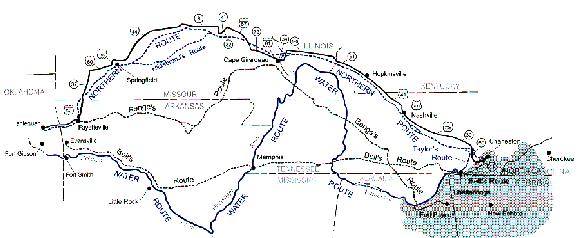
When you were born, you cried and the world rejoiced. Try to imagine for a moment what it would be like for you and your whole family to be forced to leave the only place you had ever called home: It is October, and the chill of winter is already in the air. You’ve been told that you have to leave for a new land that is a thousand miles away. You have only heard about this place in stories and you know nothing about life there. You must leave quickly with only the things you can carry. What will you take with you and what will you have to leave behind? There is no way to take enough food, water, and needed supplies. Most of your family will have to walk and what about family members who are elderly or ill… and what about the babies? How can they possibly survive the trip in winter? It seems impossible that a people would be required to leave their homes to march on foot across the country during the winter, but this is exactly what happened to the Cherokee Nation. This October marks the 165th anniversary of “The Trail of Tears” or “Nunna dual Tsuny” which in Cherokee means, "Trail where they cried". This was one of the darkest times in American history. The trail passed through our very own state of Missouri, ending in Oklahoma. This was all due to “The Indian Removal Act” which was passed by the Congress of the United States in 1830. There was only a minority of the Cherokee at the signing of the Treaty of New Echota and none of them were the elected officials of the Cherokee Nation. There were just twenty who signed the treaty but it gave all Cherokee territory east of the Mississippi River to the United States in exchange for five million dollars and new homelands in the Indian Territory in the West. More than 15,000 Cherokees protested the illegal treaty, yet it became the legal document needed to remove them. The treaty was ratified by the United States Senate, and it passed by just a single vote. Many Americans were against the Indian Removal Act and Davy Crockett was one of them. He took a strong stand supporting the Cherokee Nation. He said, “I would sooner be honestly damned than hypocritically immortalized” and he left Washington D.C., and headed west to Texas, ending his political career forever. Major John Ridge was one of the main Cherokee leaders who signed the treaty leading to the forced removal of 15,000 people from their homes in Georgia, North Carolina, and Tennessee. Thousands of men, women, and children died from disease, hunger, and exhaustion on the one thousand mile march to Oklahoma, which began in October of 1838. Actual Documentations and reports “I saw the helpless Cherokees arrested and dragged from their homes, and driven at the bayonet point into stockades. And in the chill of a drizzling rain on an October morning I saw them loaded like cattle or sheep into six hundred and forty-five wagons and started toward the west.” (Private John G. Burnett, Captain Abraham McClellan’s Company, Mounted Infantry) "Cholera broke out and death was among us hourly" "Three hundred and eleven persons drowned when an over loaded flatboat capsized". (From the log of a detachment which traveled by water) "The sick and feeble were carried in waggons-about as comfortable for traveling as a New England ox cart with a covering over it--a great many ride on horseback and multitudes go on foot--even aged females, apparently nearly ready to drop into the grave, were traveling with heavy burdens attached to the back--on the sometimes frozen ground, and sometimes muddy streets, with no covering for the feet except what nature had given them."(from the journal of a traveler from Maine who saw what was happening) A full blood survivor of the march remembered, “Long time we travel on way to new land. People feel bad when they leave old nation. Women cry and make sad wails. Children cry and many men cry, and all look sad like when friends die, but they say nothing and just put heads down and keep on go towards West. Many days pass and people die very much. We bury close by Trail.” Another survivor told how his father got sick and died: then, his mother; then, one by one, his five brothers and sisters. “One each day. Then all are gone.” By March 1839, all survivors had arrived in the West. No one knows how many died throughout the ordeal, but the trip was especially hard on infants, children and the elderly. There was a missionary doctor Elizur Butler, who accompanied the Cherokee, and he estimated that over 4,000 died--nearly a fifth of the Cherokee population. Map of the “Trail Of Tears”
~The Legend of the Cherokee Rose ~ When the Trail of Tears started in 1838, the mothers of the Cherokee were grieving A short history about the Cherokee Nation: Cherokee Indians were a progressive people compared to many tribes during that period of time. They did not live in tee pees but built log houses. They had a representation form of government and began a planned community called New Echota. The Cherokee was required to marry outside of their clan and family lines were matrilineal, being traced through the mother. After marriage a man usually lived with his wife's family Cherokee culture flourished even further when a warrior named Sequoya invented the Cherokee Syllabary in 1821. Although he was not formally educated, he spoke several languages fluently. However, it is of interest that Sequoyah could not speak or write English so his creation of a written language was a remarkable achievement. He managed to achieve a means of communication that had taken other civilizations thousands of years. It enabled anyone who could speak the Cherokee language to read or write within two weeks. In August 1839, John Ross was elected the Principal Chief of the reconstituted Cherokee Nation. Tahlequah was their capitol in what is now the state of Oklahoma. It is still the tribal headquarters for the Cherokee Nation today. About 1,000 Cherokee in Tennessee and North Carolina escaped the removal. They gained recognition in 1866, establishing their tribal government in 1868 in Cherokee, North Carolina. They are known as the Eastern Band of Cherokee Indians. Today, the Cherokee is the second largest Indian nation in the United States. It wasn’t long before the Cherokee Indians began to build homes, schools and churches in their new land but then the Civil War descended upon them. Although they fought with both North and South, they were officially aligned with the South because the South had promised them they could form an all-Indian state. Since the South was overcome, the Cherokees lost out once again. Chief Dennis Bushyhead was the Cherokee leader between 1879 and 1887. He had attended Princeton University and his first wife was a sister to Will Rogers’ mother. The son of Chief Dennis was James Butler Bushyhead and he left Indian Territory to attend the University of Missouri. More recently the Cherokees pushed litigation against the U.S. for what they considered just payment of part of their land known as the Cherokee Strip, which the government had forcibly purchased for $1.27 an acre. In 1963, the Government agreed to pay an additional $12,000,000 to the Cherokees and their descendants who had occupied the controversial territory. There is a Trail of Tears State Park, in Cape Girardeau County, Missouri, where the trail passed through the state. A memorial monument was dedicated there in 1962 to "Princess Otahki, daughter of Chief Jesse Bushyhead -- one of several hundred Cherokee Indians who died there in the severe winter of 1838-39. Our own state of Missouri was named for the Missouri Indians. They lived in earth-covered homes along the Missouri River. However, they were nearly wiped out by the Sauk and Fox Indians before the Lewis and Clark expedition. The survivors set up villages south of the Platte River in what is now Nebraska. CHEROKEE PRAYER BLESSING May the warm winds of heaven "The soul would have no rainbow if the eyes had no tears."
By
|